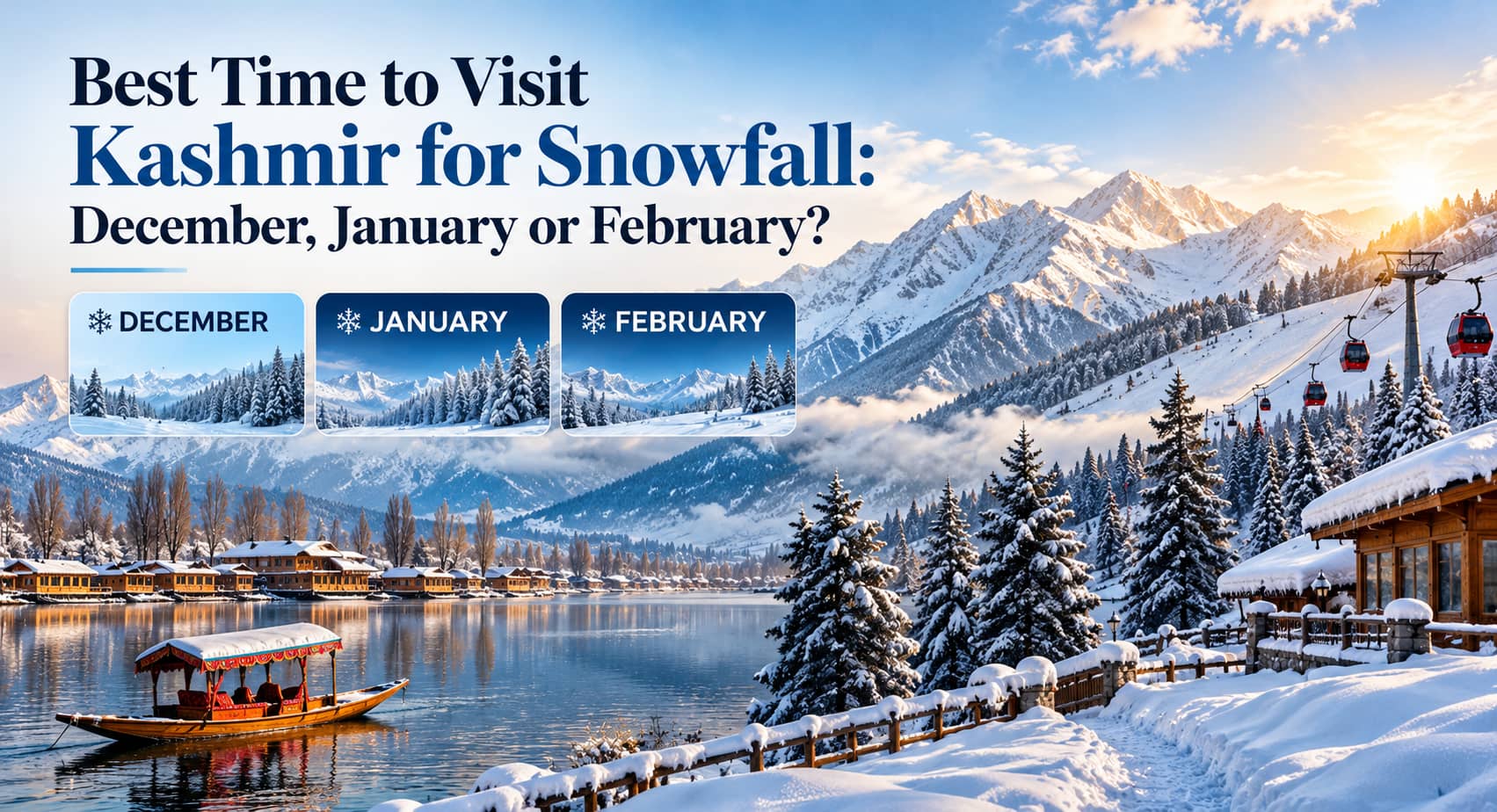
Best Time to Visit Kashmir for Snowfall: December, January or February?
If you want to see Kashmir under snow, the best time to visit is from the last week of December to the end of January. This window falls in Chillai Kalan, the coldest 40 days of the Kashmiri winter, when snowfall is most frequent across Srinagar, Gulmarg, Pahalgam and Sonamarg. February is a close second, offering deep snow cover, slightly milder days and the best skiing in Gulmarg.
That said, each month suits a different kind of traveller. A honeymoon couple, a family with children and a first-time skier will all have a different "best month." This guide compares December, January and February side by side so you can choose with confidence.
Quick answer: which month is best for snowfall in Kashmir?
| If you want… | Choose |
|---|---|
| The highest chance of seeing fresh snowfall | January |
| Snow plus Christmas and New Year celebrations | Late December |
| Deep snow cover with fewer road disruptions | February |
| The best skiing conditions in Gulmarg | February |
| Lower prices and thinner crowds | Early December or late February |
| A frozen Dal Lake (partial, not guaranteed) | Mid-January |
In short: go in January for snowfall, February for skiing and snow-covered landscapes, and late December if you want winter festivities with a fair chance of snow.
Understanding Kashmir's winter: Chillai Kalan, Chillai Khurd and Chillai Bachha
Kashmiris divide their winter into three traditional phases, and knowing them is the simplest way to time a snow trip.
| Phase | Dates (approx.) | Duration | What to expect |
|---|---|---|---|
| Chillai Kalan ("major cold") | 21 December – 30/31 January | 40 days | Coldest nights, most frequent and heaviest snowfall, water bodies partly freeze |
| Chillai Khurd ("small cold") | 31 January – 19 February | 20 days | Still very cold, regular snow spells, thick snow cover on the ground |
| Chillai Bachha ("baby cold") | 20 February – 1 March | 10 days | Cold eases, longer sunny days, snow begins melting in Srinagar |
During Chillai Kalan, nights in Srinagar often fall to between -3°C and -5°C, while Gulmarg and Pahalgam regularly drop below -8°C. This cold is what keeps snow on the ground and partly freezes the edges of Dal Lake.
One important caveat: Kashmir's snowfall depends on western disturbances, and some winters bring long dry spells. In some years the valley stays dry for weeks after a mid-December snowfall. Always check the IMD Srinagar forecast a week before you travel.
Kashmir in December: the start of the snow season
December is when winter properly arrives in Kashmir. The first half is cold and mostly dry, with snow mainly on the higher slopes of Gulmarg and Sonamarg. From around 21 December, when Chillai Kalan begins, the chance of snowfall across the valley rises sharply.
Typical temperatures: Srinagar 0°C to -4°C at night and 6–10°C by day; Gulmarg -5°C to -9°C at night.
Snow outlook: Moderate. Gulmarg usually has snow cover by mid-December. Srinagar may or may not see snowfall before Christmas.
Why go in December
- Christmas and New Year in a snow-covered hill resort, with bonfires and festive dinners
- Early December brings lower hotel rates and quieter roads
- Clear skies give sharp views of the Pir Panjal peaks
What to keep in mind
- Snowfall in Srinagar is not certain in early December
- Gulmarg's ski slopes may not be fully open, and Gondola Phase 2 can run on limited days early in the season
- Hotel prices peak from 24 December to 2 January
Best for: Couples and families who want festive cheer and are happy with snow at the hill resorts rather than guaranteed snowfall in Srinagar.
Kashmir in January: the peak snowfall month
January is the heart of Chillai Kalan and the most reliable month to experience actual snowfall in Kashmir. Srinagar's houseboats, Mughal gardens and old city lanes often turn white, and Gulmarg sits under a deep blanket of powder snow.
Typical temperatures: Srinagar -2°C to -6°C at night and 4–8°C by day; Gulmarg and Pahalgam -8°C to -12°C at night.
Snow outlook: High. This is the month with the most frequent snow spells across the valley, including in Srinagar.
Why go in January
- The best chance of watching snow fall, not just seeing old snow on the ground
- Fewer crowds than Christmas week once the New Year rush ends
- Partly frozen edges of Dal Lake on the coldest mornings
- Sledging, snowman-building and snow walks right outside your hotel in Gulmarg and Pahalgam
What to keep in mind
- It is very cold. Expect power cuts and frozen water pipes in some areas
- Heavy snowfall can close the Jammu–Srinagar highway and the Tangmarg–Gulmarg road for a day or more
- Flights to Srinagar can be delayed by fog or snow
Best for: Snow lovers, photographers and anyone whose main goal is to see live snowfall, provided you can handle sub-zero cold and keep a flexible plan.
Kashmir in February: deep snow and the best skiing
February brings the deepest snow cover of the season, especially in Gulmarg, along with slightly longer and sunnier days. The first three weeks fall in Chillai Khurd, so fresh snow spells still arrive regularly.
Typical temperatures: Srinagar -1°C to -3°C at night and 7–12°C by day; Gulmarg -6°C to -10°C at night.
Snow outlook: Good. Snow on the ground is near its peak in the hill resorts. Snowfall in Srinagar is still possible, though less frequent than in January.
Why go in February
- Peak skiing and snowboarding season in Gulmarg, with Gondola Phase 2 usually operating more regularly
- Thick snow at Gulmarg, Sonamarg, Pahalgam and Doodhpathri
- Milder afternoons, which suit children and older travellers better than January
- Hotel rates are often lower than in the Christmas–New Year window
What to keep in mind
- Avalanche warnings are more common on higher slopes; follow local advisories
- By the last week, snow in Srinagar city starts to melt and roads can turn slushy
- Ski-week dates and events in Gulmarg can push up local hotel prices
Best for: Skiers, families with children, senior travellers and anyone who wants picture-perfect snow landscapes with slightly less extreme cold.
December vs January vs February: side-by-side comparison
| Factor | December | January | February |
|---|---|---|---|
| Chance of fresh snowfall | Moderate (higher after 21 Dec) | Highest | Good |
| Snow on the ground | Building up | Deep | Deepest in hill resorts |
| Srinagar night temperature | 0 to -4°C | -2 to -6°C | -1 to -3°C |
| Skiing in Gulmarg | Early season | Good | Best |
| Road and flight disruptions | Low to moderate | Highest | Moderate |
| Crowds | Very high in the last week | Moderate after New Year | Moderate |
| Hotel prices | Highest around Christmas–New Year | Medium | Medium |
| Comfort for kids and seniors | Good | Challenging | Good |
Which month should you choose?
- Honeymoon couples: Late January or February. You get snow, cosy stays and fewer crowds than Christmas week.
- Families with young children: February. Snow is plentiful, but days are a little warmer.
- First-time snow seekers: January, for the best chance of seeing snow actually fall.
- Skiers and snowboarders: February, when Gulmarg's slopes and Gondola Phase 2 are at their best.
- Budget travellers: Early December or the last week of February, avoiding festive peak pricing.
- Senior citizens: February, with a stay in Srinagar and day trips to the snow resorts.
Best places to see snow in Kashmir in winter
Gulmarg
Kashmir's most reliable snow destination and India's best-known ski resort, about 50 km from Srinagar. The two-stage Gulmarg Gondola climbs to roughly 4,000 m near Apharwat Peak. In 2026, reported fares were around ₹800 for Phase 1 and ₹1,000 for Phase 2. Phase 2 tickets are limited and the ride often stops in high winds, so book early and keep a backup day.
Sonamarg
Sonamarg used to shut for four to five months every winter. Since the Z-Morh tunnel opened in January 2025, it has been reachable year-round and is now a growing winter destination with snowfields, sledging and quieter slopes than Gulmarg.
Pahalgam
About 95 km from Srinagar, Pahalgam is often one of the coldest places in the valley in January. Betaab Valley, Aru Valley and the Lidder river look stunning under snow, though some side roads may be closed after heavy snowfall.
Srinagar
Snowfall in Srinagar is most likely in January. A shikara ride on Dal Lake surrounded by snow-covered houseboats is one of the most memorable winter experiences in Kashmir.
Doodhpathri
A quieter meadow about 42 km from Srinagar, known for wide, untouched snowfields. Access depends on road clearance after snowfall, so check locally before going.
How to reach Kashmir in winter
Flying into Srinagar is the most practical way to reach Kashmir in winter. Direct flights operate from Delhi, Mumbai, Bengaluru and other major cities, and the Delhi–Srinagar flight takes about 1.5 hours.
- By air: Srinagar International Airport is about 15 km from the city centre. Morning flights can be delayed by fog or snow, so avoid tight connections on your return.
- By train: Trains run to Jammu Tawi or Katra, with onward rail service to Srinagar via the Katra–Srinagar line. Check current schedules, as winter weather can affect services.
- By road: The Jammu–Srinagar highway (about 250 km) can close for a day or more after heavy snowfall or landslides. Track the traffic advisory before setting out.
Inside the valley: Hire a local cab with a driver who has winter experience. On the final climb from Tangmarg to Gulmarg, local taxis with snow chains may be required after snowfall.
How much does a Kashmir winter trip cost?
A 5-night, 6-day Kashmir snow trip typically costs about ₹18,000–₹25,000 per person on a budget, ₹30,000–₹45,000 for mid-range comfort and ₹60,000 or more for a premium trip, including return flights from Delhi.
| Expense (per person, twin sharing) | Budget | Mid-range | Premium |
|---|---|---|---|
| Return flights (Delhi–Srinagar) | ₹7,000–₹10,000 | ₹10,000–₹14,000 | ₹15,000+ |
| Stay (5 nights) | ₹6,000–₹9,000 | ₹12,000–₹20,000 | ₹30,000+ |
| Local cab (Gulmarg, Pahalgam, Sonamarg) | ₹3,000–₹4,000 | ₹4,500–₹6,000 | ₹8,000+ (private SUV) |
| Food | ₹2,000–₹2,500 | ₹3,000–₹4,000 | ₹6,000+ |
| Gondola, shikara, gear rental | ₹2,000–₹3,000 | ₹3,000–₹4,500 | ₹5,000+ |
| Total (approx.) | ₹18,000–₹25,000 | ₹30,000–₹45,000 | ₹60,000+ |
These are indicative ranges. Flights and hotels can cost 40–60% more during Christmas and New Year week. Choose hotels with central heating or reliable room heaters; it makes the biggest difference to comfort in January.
What to pack for a Kashmir snow trip
Kashmir in winter is colder than most Indian hill stations, so pack for sub-zero temperatures and wet snow.
- ☐ Two sets of thermal inner wear
- ☐ Heavy down jacket or a long padded coat (locals wear the woollen pheran, which you can buy in Srinagar)
- ☐ Waterproof snow boots with good grip
- ☐ Woollen cap, waterproof gloves and a muffler
- ☐ Thick woollen socks, several pairs
- ☐ Sunglasses and SPF 30+ sunscreen for snow glare
- ☐ Moisturiser and lip balm
- ☐ Personal medicines and a basic first-aid kit
- ☐ Power bank (cold drains phone batteries fast)
- ☐ Some cash for local taxis and small shops
Winter safety tips for Kashmir
- Keep one or two buffer days. Snow can close highways, the Gulmarg road or Srinagar airport.
- Check advisories daily. Follow the J&K traffic police and IMD Srinagar updates for road closures and snow warnings.
- Book the Gulmarg Gondola early through the official portal and avoid touts selling tickets at inflated prices.
- Avoid Gondola Phase 2 if you have heart or breathing problems; the altitude is about 4,000 m.
- Respect avalanche warnings and never go off marked slopes without a certified guide.
- Carry ID at all times, as security checks are routine.
Frequently asked questions
Which is the best month to see snowfall in Kashmir?
January is the best month to see fresh snowfall in Kashmir, including in Srinagar. It falls in the middle of Chillai Kalan, when snow spells are most frequent.
Does it snow in Kashmir in December?
Yes. Gulmarg and Sonamarg usually have snow by mid-December, and the chance of snowfall in Srinagar increases after 21 December. It is not guaranteed every year.
Is February good for a Kashmir snow trip?
Yes. February has the deepest snow cover in Gulmarg, the best skiing conditions and slightly milder days, making it a strong choice for families and skiers.
What is Chillai Kalan in Kashmir?
Chillai Kalan is the 40-day period from 21 December to about 30 January. It is the harshest part of the Kashmiri winter, with the coldest nights and the highest chance of snowfall.
Does Dal Lake freeze in winter?
Dal Lake partly freezes, mainly along its edges, on the coldest nights of January. A fully frozen lake is rare and should not be expected.
Is Sonamarg open in winter?
Yes. Since the Z-Morh tunnel opened in January 2025, Sonamarg can be reached year-round, though roads may close briefly after heavy snowfall.
How many days are enough for a Kashmir winter trip?
Five to six days covers Srinagar, Gulmarg and Pahalgam comfortably, with one buffer day for weather. Add a day for Sonamarg or Doodhpathri.
Is Kashmir safe for tourists in winter?
Kashmir receives large numbers of tourists every winter. The main risks are weather-related, such as road closures and icy surfaces. Follow local advisories and travel with experienced drivers.
Plan your Kashmir snow trip with GoTrips
The right month depends on what you want most: January for snowfall, February for skiing and deep snow, or late December for festive winter magic. Whichever you choose, book early, keep a buffer day and stay in heated hotels. GoTrips offers Kashmir winter packages covering Srinagar, Gulmarg, Pahalgam and Sonamarg, with flexible itineraries planned around road and weather conditions.
Sources
- Chillai Kalan and Kashmir winter temperatures – Greater Kashmir
- Chilla-i-Kalan, the harshest winter period – Kashmir Reader
- Gulmarg Gondola guide 2026 – Travel Coffee
- Gulmarg trip guide 2026 – Zoutons
- Z-Morh tunnel opens Sonamarg year-round – Kashmir Life
- Sonamarg winter tourism after Z-Morh – Punjab Kesari